• Skip to main content
  • Skip to footer

melloInsurance

Serving our clients, Serving our community

  • About Us
  • Blog
  • MySGI
  • Claims
  • Get a Quote
  • Contact Us

Lyndon Block

The “Need-to-knows” for Solid Fuel Heating

-52, -46, -38, -37, -42; Those are just some of the recent temperatures we have been gifted. As a whole, the winter has been surprisingly gentle. However, when these winter temperatures arrive with little warning, we need to be prepared. This goes a step further than scheduling your thermostat in your home to a few degrees warmer. As a precaution, many people install backup heating in their house in case of these low temperatures, especially if they come alongside a power outage. We recommend having a backup plan in case this situation were to ever arrive. Blowing out your water lines to prevent freezing/rupture would be a good idea if you are unable to warm your home. If you are deciding to add a solid fuel heating device to your home for backup heating, this is what you need to know.

Step 1 – What should I buy or install?

If you are deciding between a fireplace or woodstove, here are some things to note. If you install a zero clearance fireplace (whether it is wood, propane or nat. gas), we do not need to inspect the unit, and it does not add a surcharge to your policy. We do, however, need to be notified that this has been added to increase the replacement cost of your home, and to notify the insurance company that there has been a material change. Any time you make changes to your policy that have been defined as “substantial,” you need to immediately notify your insurance broker as this may increase the risk of insuring your property. If you do not notify the insurance company, this change could potentially VOID your coverage due to the changes.


If you decide to purchase a wood stove, here is some information you’ll need to know.

  • The unit must be CSA, ULC or Warnock Hersey approved
  • The unit will need to be installed to meet manufacturers specifications
  • The unit must sit on a non-combustible floor pad meeting CSA requirements
  • If an unapproved unit is being purchased, you must follow B365-17 requirements of an unapproved installation.
  • Any wood stove used as auxiliary heat comes with a surcharge that is added to their home insurance. This can range between 10 – 35% of your home insurance premium.
  • A high-temp CSA approved chimney is required to be used for the wood stove, meeting manufacturers requirements.
  • If you are purchasing a used unit, make sure the unit has been ONLY burning wood. Some people use these units to burn garbage or other items that can cause distress to the integrity of the stove as the burn more inconsistently than wood.

STEP 2 – Installation

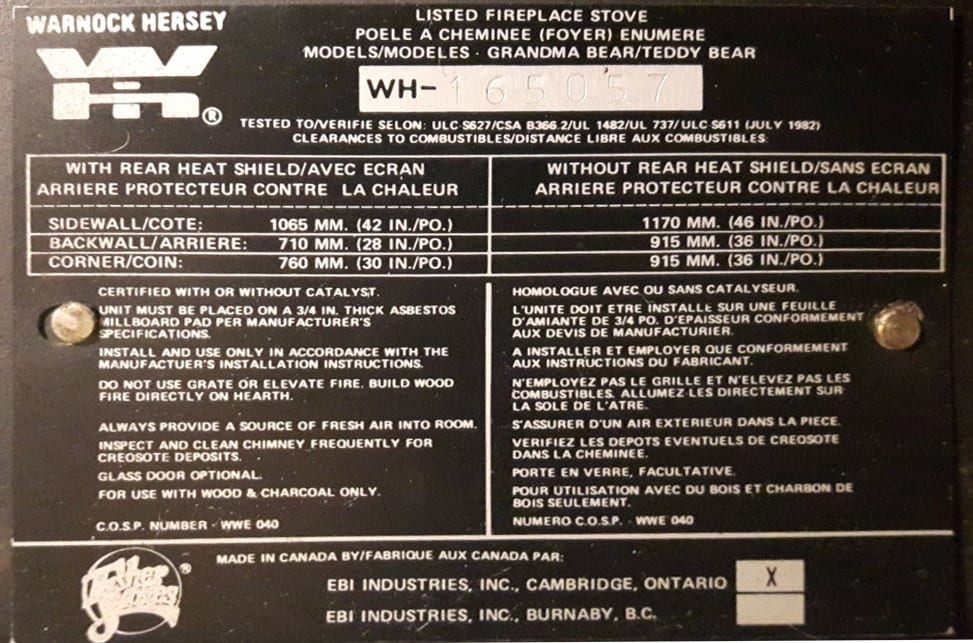
When you install your new or used unit, you need to follow the manufacturer’s guidelines stipulated on the manual of the wood stove. If your unit does not come with a manual, these clearances are indicated on the back of the stove on a steel decal riveted to the stove. NOTE: If the stove does not have that decal on the stove, the unit is NO LONGER CSA approved and you will have to follow the unapproved clearances listed in the B365-17 manual. A example of this decal is shown in the photo below. 


If you want your unit WETT inspected, please contact a WETT inspector near you. Lyndon Block in our office is WETT certified and can do that inspection for you. If you have your insurance policy with our brokerage, he will inspect it as a service to you. Otherwise, there is a small charge for the costs incurred to do the inspection. Some things an inspector will look at include:

  • Installation of unit, stovepipe and chimney meeting manufacturers requirements
  • Stove pipe construction, direction of piping and angle/slope.
  • Stove pipe joint security and allowance for flexibility
  • How many elbows (max 2 elbows – 180 degrees of change)
  • Non-combustible floor pad (construction, clearance)
  • Distance to fuel/combustibles
  • Wall pass-through & ceiling bucket installation (thimble)
  • Chimney clearance above roof and other neighbouring roofs
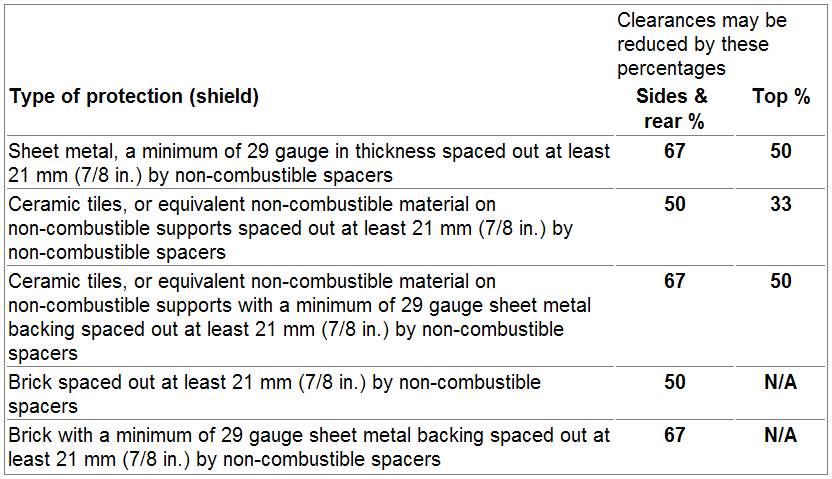
  • Installation & material of wall shielding to reduce clearances of stove and stovepipe to combustibles (Diagram below)

Those are the main things, however, every installation and situation can vary, please contact your broker or WETT inspector to find out more information on how to properly install your unit.

STEP 3 – Insurance Approval

To insure the new unit, your insurance broker/company will need to have someone inspect the unit and take photos indicating the clearances and installation matches the requirements indicated by your wood stove manufacturer. Once the company has approved the installation, ONLY THEN are you allowed to start using it. Talk to your broker to see what the insurance company you are currently with charges for having a wood stove installed in your dwelling.

If you are installing a wood stove in your cabin or seasonal cottage, this has very different implications. A surcharge is very rarely applied as this will be used more infrequently, sometimes an inspection is not even required, depending on the company and the situation. Having your broker review some photos is usually a good idea to show the installation and confirm there isn’t any potential fire hazard.

STEP 4 – Using the solid fuel heating device & maintenance

Burning only wood, (particularly seasoned/low moisture wood) helps burn more effectively, giving your home a warmer, cleaner burn. By having a cleaner burn, you reduce the chance of creosote building up in the chimney/stove pipe. It is important to clean the unit and chimney regularly. Having a chimney sweep done before and after the heating season is a good habit to have. Also, DO NOT burn any accelerants, or garbage of any kind in the stove as this will hurt the integrity of the stove and reduce life expectancy of the stove greatly.

There is a lot that goes into installing a solid fuel heating device. A lot of preparation to make sure the unit is a good fit for your home, your home insurance and if you are prepared for the financial implications that come along with it. This may seem like a lot of work and red tape, but there is a reason for everything, and we want you to make sure that the installation of your unit is done properly for you and your family’s safety. Stay warm and stay safe.

Is it time for my roof to be updated?

In Saskatchewan, we have many elements of weather. Whether (no pun intended) it is wind, hail, snow, ice, cold, hot or all of the above. We get hammered with it all at different times of the year. To have a building withstand all these elements is quite an accomplishment. However, it does result in a quicker lifetime for many materials in this climate. I don’t know about you, but if I’m working in -30’C or in gale force winds, my efficiency and work ethic takes a bit of a hit. Here is some information for you and how it affects your insurance policy.

Effective 2018, SGI Canada and many insurance companies decided to take a new approach to adjust roof claims. They were now going to apply “depreciation” to roofing materials/labour if damaged by wind or hail. Depreciation is the loss in value due to wear and tear on that particular item.  The reason for this change was that that there is a direct result of the roofs of buildings being worn down due to years of brutality from the elements and factors in our Canadian climate. This causes the life expectancy of our building materials (particularly roofs) to drop.  Here is comparison between an architectural shingle and a typical 3-tab shingle. 

If you have a roof that is 16 years or older, and you have a roof claim for wind or hail, a certain percentage will be deducted from your settlement based on the roofing materials installed on the roof. The table below shows what kind of depreciation will come off your roof in an insurance claim, depending on the materials used. If you are unsure about whether your roof should be replaced or not, contact a contractor through our Kijenga app on our claims section, or find a local roofing contractor to give you an estimate. You don’t want to have a “seepage” issue in your home due to old shingles leaking. Seepage is typically not covered on most policies. 

Roofing Material Used Annual Depreciation
% after 15 years
Asphalt/fibreglass composition shingles (Class 1-3)

10%

Asphalt/fibreglass composition shingles (Class 4)

7%

Architectural Shingles

7%

Membrane Roofing

5%

Metal, Rubber, Synthetic, Polymer, Tiles, Slate, Concrete

2%

Wood Shingles or Shakes

4%

Built-up (Tar & Gravel)

30%

Other

9%

Soffit, fascia, eavestroughs, downspouts connected to eavestroughs

5%

NOTE: Maximum depreciation is 80%, regardless of age.

For example, you have a 19 year old roof with architectural shingles. In this case, SGI Canada would pay to have your roof repaired or replaced, minus 28% depreciation (7% per year for 4 years).

If you have qualified and purchased the SGI Canada “Prestige” policy this would not apply to your home and you would qualify for full replacement coverage for the damages. Please contact us to see if you qualify for this package or want to know more about it. Next week, we will discuss more about this Prestige package and what protection it can offer you and your family.

How can business interruption insurance protect me?

There are many interruptions in life, some are good, some are bad. Children interrupting you, although cute, can be slightly annoying. Someone who is talking to you is interrupted by their cell phone ringing; quite common. An unborn child coming sooner than the expected “birthdate;” exciting, terrifying, all the emotions.  A Tornado deciding to drop by and remove half of your barn & re-locating your livestock; slightly inconvenient. Or a boiler explosion in your manufacturing plant. “Heads up!” These are scary scenarios that can cause some serious disruption in your day to day and can interrupt your business workflow.

What can be done?

The first few scenarios can be handled by adjusting your expectations. For the later two, you might need an actual game plan. Typically, people insure their buildings, equipment, tools, vehicles & finished products (stock) and that is mostly what they are concerned with. However, there are many businesses that would be in serious trouble if they do not insure for “business interruption.”  

Okay, so what is this “business interruption” coverage?

Business Interruption Insurance covers the loss of income that a business suffers after a disaster. Despite insuring the assets of your business, you may be unable to continue your business operation for 6 to 12 or even 18 months after the loss. While the demolition/rebuild is underway, you are continuously losing revenue. The unfortunate part is that you will likely continue having expenses throughout this time: Payroll, Mortgage, Taxes, Other business Loans, Utilities, etc. Now, if you aren’t able to bring in revenue, how will these expenses get paid? This is when business interruption coverage kicks in.

There are different types of business interruption coverage terms to keep in mind:

  1. Gross Profits Form – This covers the loss of net profit following the reduction in revenue, standing charges and any increased costs of business. For example, you need to rent a building or equipment to continue business operations temporarily. This is suitable for businesses in retail & manufacturing sectors.
  2. Gross Revenue Form – This covers the reduction in revenue following the loss and any increased costs. This is suitable for businesses in the service industry – accountants, solicitors, hotels.
  3. Actual Loss Sustained – This covers the actual loss sustained by the insured as a result of the physical loss insured by the policy. This only applies when the insured actually sustains a business interruption. If he is able to continue operations immediately following the loss, this coverage does not kick in.
  4. Extra Expense – a necessary expense that the insured was required to make, to prevent further damages in an unexpected loss. For example, you have a sewer backup and you quickly react by buying a sump pump, rent a hydro vac and other expenses to prevent the sewer backup from hitting your mechanical room and equipment therein. If sewer backup coverage is on the policy, the loss is covered and the costs to prevent further damage will also be covered under this extra expense provision.
  5. Period of Restoration – this is to determine how long your business could be down during a loss; aka: “Worst Case Scenario.” With this timeframe in mind, the value of business interruption coverage can then be calculated.  

So let’s use an example:

You have a kitchen-cabinet business. You generate $600,000 Gross, annually. Your shop value with debris removal is $500,000. You have $200,000 in tools and equipment and $150,000 of pre-finished cabinets finished inside. You have purchased a comprehensive contractors policy with business interruption and data recovery. Some dust catches fire by the saw in the shop and burns down the shop, equipment, tools and pre-built cabinets. As predicted, the main items are insured and covered on the policy. You’re now looking at how you can continue business while your shop and equipment is rebuilt/re-ordered. The expected timeframe to get the debris cleaned up and another shop built and operational is 12 months. Two months later you are able to find another shop in town to rent use their tools. This coverage extends to the time you were down without any income while searching for the shop. It covers the rent payments for the rented shop/equipment and it covers any additional business costs that are required to continue business operations as usual.

Calculations:

  • 2 month down = $100,000 revenue lost to cover cost of expenses (Payroll, Mortgage, etc.)
  • Shop/Tool Rental is $7000 per month for 10 months = $70,000.
  • Additional costs to transport products to/from rental shop = $10,000
  • Debris Removal Costs = $20,000
  • Shop Rebuild = $480,000
  • Cost to replace tools & equipment = $200,,000
  • Inventory/Stock = $150,000
  • Data Loss / Recovery (Accounts Receivable, Payables, etc.) = $25,000

Total insurable loss = $1,055,000                   Total business interruption loss: $180,000

So who needs this coverage?

This is  decided on a case by case basis. Not every business is the same and therefore the risks are all different. You may have a welding shop or be a mobile welder, and so one may require this coverage and the other may or may not depending on his circumstances. It is important to be as thorough as possible when explaining the nature of your business to your insurance broker, this will help us design the coverage that will best fit your business. We do not want you left stranded in a pile of ashes with bills piling up. We are here to help bail you out of those terrible situations. Being detailed with us, helps us to make sure those loopholes are filled.

When tragedy or crisis hits, the last thing you want to be worrying about is where are you going to find your next paycheck. Let us take care of those details for you so you don’t have to. As always, thanks for reading and take care!

My truck just fell through the ice….now what!?


We live in Saskatchewan. Which means 3 things: you bleed green, you know what a combine is, and you know how to survive winter 11 months of the year. I might have exaggerated………just on the combine one, the point is, winter is here and it is here for a while. So we have to make the most of it. That means it is time to go out for a rip to the fishing shack!

If you live in this glorious province that has an unlimited bounty of frozen lakes and tundra, you may know, or in fact, BE, a die hard ice-fisher (New word of the day). Get the ice-auger and a few beverages and make your way across the frozen pond, where you can enjoy yourself trying to catch that elusive slippery fish.

Now this is all fine and dandy, but what happens in the event that the ice isn’t as thick as you thought and your trailer or truck ends up falling through the ice? We have all seen the instagram or snapchat photo showing some redneck digging a truck out of the ice-water with a backhoe. We don’t want that to be you! But if that redneck turns out to be you or a close relative, you may need to know if you’re actually covered on your insurance.

Truth is, SGI does not have a magic number of how thick the ice needs to be for you to be “approved” to drive onto the ice. We were able to find a guide to show an approximate thickness allowance for certain vehicles. This is shown below. Even though these guidelines are complete speculation, they give you an idea of what weight can be placed on certain thicknesses of ice.  

SGI states that if a claim were to occur from a vehicle falling through the ice: “As long as it was reasonable for the customer to believe that the ice would hold the weight of the vehicle, then you should be covered for any loss or damage to your vehicles. If the customer saw large patches of open water or he tried to hydroplane his snowmobile or anything risky; those would be scenarios where a claim could be denied.”

Try to break up the winter with some quality ice fishing time, and just know that, as long as you believe the ice is thick enough for your vehicles, then you’ll be covered. It is better to be safe than sorry, so it wouldn’t hurt to check out the depth of the ice prior to driving your new Super Duty onto it. Cheers!

Mandatory Alcohol Screening

During this Christmas season there will be many parties to attend. Whether they are work parties, family gatherings or a New Years Eve party. Whatever the agenda is, it is important to always plan a safe ride home.

Effective December 18th, 2018, New legislation has passed – Bill C46 – which allows law enforcement to conduct mandatory alcohol and drug screening tests. This means that if you are pulled over or are pulled into any random check stop across the country, a police officer can demand a breathalyzer test be taken even if the motorist has no signs of impairment. Prior to this bill being passed, an officer had to have reasonable grounds to pull you over.

Provincial legislation had also changed the impaired driving legislation limit to .04 back in 2017. This meant tougher penalties for a lower legal limit. Penalties such as having your vehicle seized for up to 3 days, attending an impaired driving education program and possibly having your drivers licence suspended. There is a zero tolerance for drivers under the age of 21. The criminal offence still is effective at .o8. For more information on impairment penalties, please click here.

Also, to help with the prevention of impaired driving, effective December 14th, 2018, Ride sharing companies such as Uber & LYFT are now available. If you choose to be a driver for one of these programs, you may need to upgrade your drivers license and amend your personal auto pak to a commercial auto pak to extend coverage properly to this ride sharing operation. Please contact your broker for more information or a quote on these coverages.

We want you to have a safe and Merry Christmas and Happy New Year. Please enjoy the holidays with your family and friends.


Is there a reason I have identity theft coverage?

Remember a couple weeks ago when we spoke about the importance of having someone checking your home while away on that warm vacation that you “won” by taking that telemarketer survey?  Well, unfortunately that trip resulted in having your information getting stolen and your personal identity being compromised. Credit cards were forged and now you have charges in your name that shouldn’t be there!  Why oh why was that telemarketer so convincing? Now you are sitting in a world of hurt and anguish, you are confused and have misplaced emotions, and wondering how you will escape the clutches of this unfortunate event.  You grab your favorite blanket, lay down on the sofa and proceed to have yourself a good cry as you wonder what to do.


Suddenly it dawns on you and you stop your panic.  The clouds of broken trust and fear begin to roll back with the glorious blue sky and warm sun shining down on this situation.  You remember that your insurance provider has got you covered! Most companies offer a minimum of $10,000 of identity theft protection that will help you get your life back in order.  This coverage will kick in to cover the costs of getting new documents produced, as well as kick in to cover unauthorized credit card charges that might exist. This coverage can be used any time you suspect that your identity has been compromised.  The claims process is started simply by contacting your broker who will open up a claim on your behalf with your insurance company. Submitting a claim for this type of loss may cause a change in premiums due to discounts being affected, so be mindful of that fact if you should decide to pursue this option.


Identity theft protection.  Who knew you would ever need such a coverage?  Your broker did that’s who! Once this whole disaster blows over and what was lost has been returned, make sure you take the time to thank your broker and maybe even bring them that Iced Cap that they love so much.  Brokers know that they often look like the hero, but deep down they are just regular people that want to help and see your problems through.

No matter what happens in the future, keep your broker close.  You never know when you will need them to help you out of the proverbial hole you find yourself in!


  • « Go to Previous Page
  • Go to page 1
  • Interim pages omitted …
  • Go to page 4
  • Go to page 5
  • Go to page 6
  • Go to page 7
  • Go to page 8
  • Interim pages omitted …
  • Go to page 17
  • Go to Next Page »

Footer

Waldheim Office

3006 Central Ave
Box 70
Waldheim, SK, S0K 4R0

Office: 1-306-945-2353
Fax: 1-306-945-5515
Email: waldheim@blocksagencies.ca
Contact the Waldheim Office

Hours (Mon – Fri):

8:30am – 12:00pm
12:30pm – 5:00pm

Rosthern Office

1012 6th St
Box 66
Rosthern, SK, S0K 3R0

Office: 306-232-5525
Fax: 306-232-5112
Email: rosags@rosthernagencies.com
Contact the Rosthern Office

Hours (Mon – Fri):

8:30am - 12:00pm
1:00pm - 5:30pm

Langham Office

#101-322 Park Avenue,
Box 10
Langham, SK, S0K 2L0

Office: 1-306-283-4155
Fax: 1-306-283-4177
Email: langham@blocksagencies.ca
Contact the Langham Office

Hours (Mon – Fri):

9:00am – 12:00pm
1:00pm -5:00pm

Borden Office

106 Shepard Street
Box 220
Borden, SK, S0K 0N0

Office: 1-306-997-2169
Fax: 1-306-997-2168
Email: borden@blocksagencies.ca
Contact the Borden Office

Hours (Mon – Fri):

9:00am – 12:00pm
1:00pm -5:00pm

Copyright © 2026 · Block's Agencies · Privacy Policy · Website Admin